Rick Rosner: You had ChatGPT summarize my life using publicly available sources, which it processed into a coherent narrative. There were several minor errors—for example, it claimed I spent ten years in high school. That is inaccurate. I returned to high school a few times over the course of a decade, but I did not attend for ten continuous years.
Despite these inaccuracies, the summary presented a clear and compelling story. It identified key themes in my life, which is notable. I have lived according to certain recurring ideas, and it successfully recognized and organized them. It was impressive. Each claim included a source citation, which added credibility. That said, the quality may reflect strong summarization of sources more than independent insight.
Scott Douglas Jacobsen: We’re at a turning point with AI, particularly in language models. Because these tools work with language—the medium we rely on most—they feel especially impactful.
Artificial General Intelligence (AGI), defined as systems that act in the world rather than only process text, will be fundamentally different. Still, scaling improvements are significant. For example, the jump from GPT-3.5 to GPT-4o might represent a tenfold improvement. Integration across systems is another major step.
Rosner: You asked about multimodality.
Jacobsen: Technically, modality refers to sensory data, but AI developers often use the term differently. If five distinct systems can be integrated so that each fully interoperates with the others, the increase in capability could match or exceed the jump from GPT-3.5 to GPT-5o.
Even small updates—such as shifting the model to a more powerful server—can noticeably improve performance. Integration across varied modalities, and increasing processing power to unify them, is likely the next major leap. At that point, we may begin to approach truly general AI, or something that functions as such through AGIs.
Well, in the sense that if we’re using humans as a benchmark—and that’s typically the default—we assume the human brain and body as the standard: movement, language generation, and integrating both to make plans, act in the world, and communicate.
So, yes, we have the five basic senses. To replicate that in AI might require a similar scaling progression—from something like GPT-3.5 to GPT-5o. But I would argue motor processing is probably far less computationally intensive for machines than it is for us, even though it has been a challenging problem to solve. I think language is far more processing-intensive, and we are already making significant progress there.
Rosner: You mentioned five senses, but there are many others that could be developed artificially. The five human senses just happen to be well-adapted to our evolutionary needs. But machines can have others. For instance, some forms of artificial intelligence have been designed with magnetic field detection, and that’s just one example.
Jacobsen: Then there are derivative senses—like proprioception—which are combinations or extensions of the basic ones. I think it’s very possible to build on those. But integrating them would just require another order of magnitude in processing power—a 10x scale-up, as with earlier transitions.
Machines will likely be able to take in broader bands of the light spectrum, for example—far beyond what we can naturally perceive.
Rosner: Alright. Let’s move on.
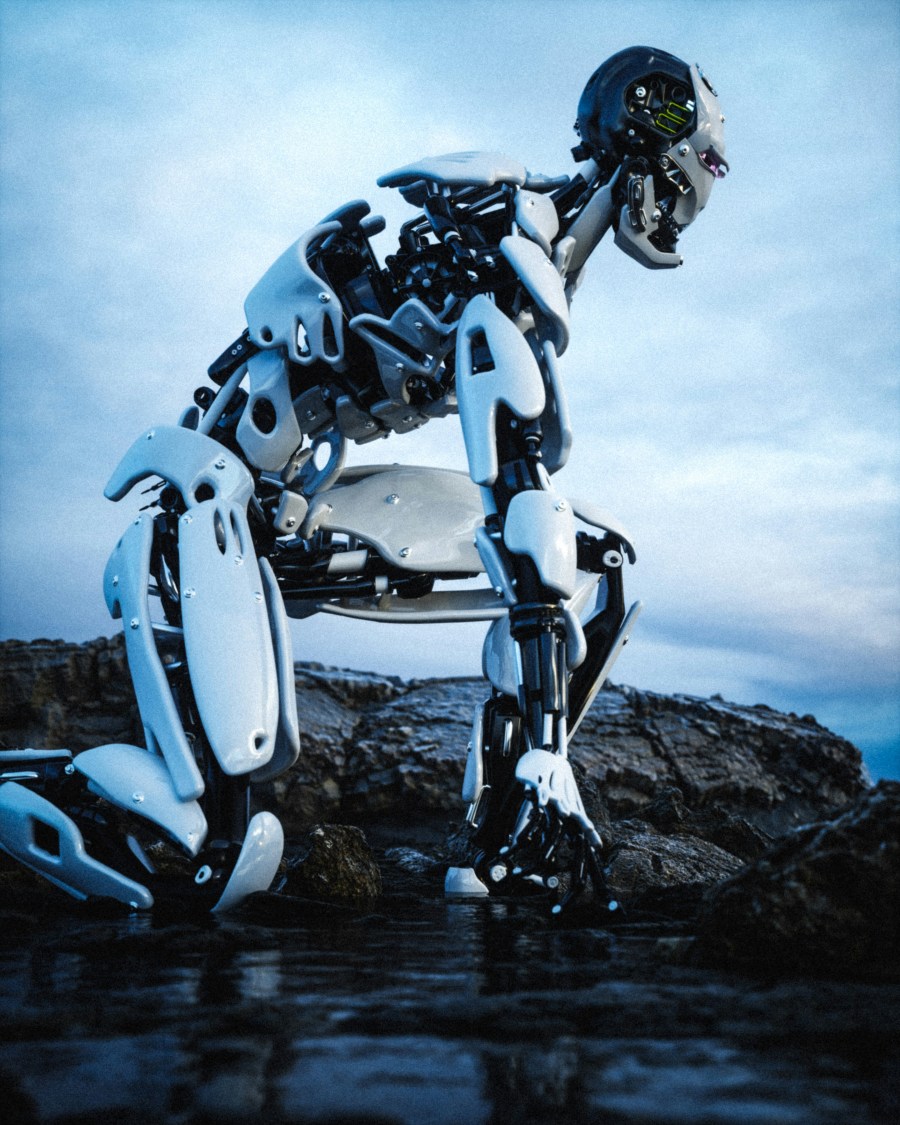
Photo by Cash Macanaya on Unsplash
Rick Rosner is an accomplished television writer with credits on shows like Jimmy Kimmel Live!, Crank Yankers, and The Man Show. Over his career, he has earned multiple Writers Guild Award nominations—winning one—and an Emmy nomination. Rosner holds a broad academic background, graduating with the equivalent of eight majors. Based in Los Angeles, he continues to write and develop ideas while spending time with his wife, daughter, and two dogs.
Scott Douglas Jacobsen is the publisher of In-Sight Publishing (ISBN: 978-1-0692343) and Editor-in-Chief of In-Sight: Interviews (ISSN: 2369-6885). He writes for The Good Men Project; International Policy Digest (ISSN: 2332–9416); The Humanist (Print: ISSN 0018-7399; Online: ISSN 2163-3576); Basic Income Earth Network (UK Registered Charity 1177066); A Further Inquiry, and other media. He is a member in good standing of numerous media organizations.
License & Copyright
In-Sight Publishing by Scott Douglas Jacobsen is licensed under a Creative Commons Attribution-NonCommercial-NoDerivatives 4.0 International License. ©Scott Douglas Jacobsen and In-Sight Publishing 2012-Present. Unauthorized use or duplication of material without express permission from Scott Douglas Jacobsen strictly prohibited, excerpts and links must use full credit to Scott Douglas Jacobsen and In-Sight Publishing with direction to the original content.
 Rick Rosner