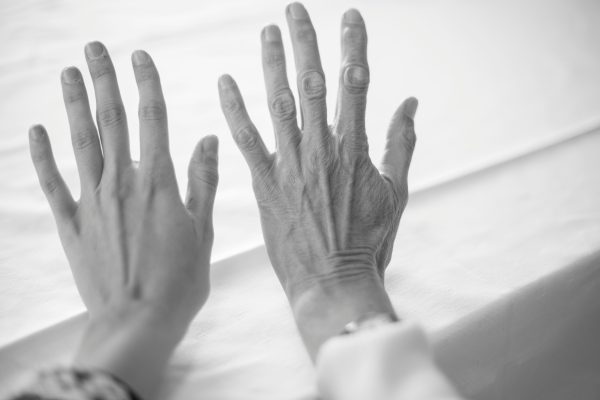
If you could control a timeline—your senses, and the loss of sense and mobility as you have gotten older—what order would you lose them in?
Scott Douglas Jacobsen interviews Rick Rosner on aging, beauty, intelligence, and social adaptation. Rosner reflects on sensory loss, arguing he would surrender smell first and protect vision last. He recounts youthful insecurity, cosmetic surgery decisions, and how fame reshapes standards of attractiveness. The discussion broadens into romance, marriage, and durability, framing long-term counselling as an overlooked form of devotion. Rosner introduces his concept of“smart-stupid,” warning that intelligence can mislead when it rejects proven social rules. Using street-crossing metaphors and pop culture, he argues that not everything benefits from reinvention, and that maturity often means learning when not to optimize.
Scott Douglas Jacobsen: If you could control a timeline—your senses, and the loss of sense and mobility as you have gotten older—what order would you lose them in?
Rick Rosner: I do not know. I would give up smell first. If you give up smell, you lose much of your sense of taste, because taste is mainly dependent on smell. But I have never been very good at smelling things so that I would give that up first. Beyond that, I do not want to give up anything. Vision is the last thing I would like to lose. All right. We do not have to talk about what you do not want to. You had surgery on your nose? How many times, in what way, and why? A friend of mine—Charlie Weidman—had his nose smashed by a basketball in sixth or seventh grade, and it was reconstructed. I remember thinking it looked great afterward and suited his face. He always had a girlfriend. I thought he had terrible taste in girlfriends, but he always had one in high school. I could not get a girlfriend. My nose was not horrible, but it was not great—especially in a very blonde, white town where noses tended to be small. I started working in bars because I thought someone might smash my nose, and I could get a new one. It never happened. Drunks were bad at hitting people. I never even got a black eye, because their punches were weak, and my face has a lot of bony structure. Eventually, I gave up and went to NYU, where I say I got a “practice” nose job for free because they needed cases to practice on. I did not have my nose completely re-engineered. They moved my nostrils in a little and took a little bit off. It was not much, but it gave me a nicer nose. The difference between me being as handsome as I am and as handsome as I would want to be is not easily solved. I think the easiest way to become attractive is to become so famous that your face is recognizable and people decide it is a decent way to look. I believe that is what happens with actors like Dustin Hoffman, who became widely known after The Graduate (1967).
It would take major reconstructive surgery on my face to get it close to the modern standard for really handsome. I learned about a procedure later. It was not available during my plastic surgery years. Instead of giving you a chin by slicing open the area between your lip and gum and inserting a piece of silicone to create a small knob—which does not accomplish much—they now do something more extensive. A chin implant helps a little if you have a weak chin, but what you really want is the whole procedure, which gives you a complete “Batman” jaw. They run silicone from the chin along the jawline and build out the area at the hinge of the jaw, giving you a strong, angular jaw—the full-on good-looking jaw, the Mini Driver jaw. I do not think that was available back in the 1980s, but it would have gone a long way toward giving me the look I would have wanted. Even Duchovny, who has a weak chin, has a wide jaw at the back. Nobody cares about his weak chin because his jaw is firm. That is what would have helped. What really would have helped is having the kind of personality where it does not matter what I look like. I have managed to get some of that, but not enough, and not early enough. On the other hand, I have been married to Carole for nearly thirty-five years, so who cares at this point? Rotten tomatoes. Tim Leary may or may not have had his head shot into space. Would you like to go that way? No. I want to be cryonically preserved if there is no other option, because I want a shot at preservation.
Jacobsen: What is the most romantic thing you have ever done?
Rosner: I made my college girlfriend a tiny gold raft. I met her just after she returned from a whitewater rafting trip, and I made it using lost-wax casting. I found a small raft in a model kit—it was a life raft for a battleship. I made her a golden raft on golden waves, which I made sparkly by buying cheap diamonds and smashing them with a hammer. That defeats the purpose of diamonds, because once they are broken, they are less sparkly. Still, I made the whole thing. It took a long time, and it was pretty cool. I do not know whether she appreciated it. Another romantic thing is staying married to Carole for thirty-five years and going to couples counselling since before our child was born—about thirty-two years of counselling. We have good insurance that pays for it. Thirty-two years of counselling is an extraordinary amount of work. Working on a marriage for decades to make sure it remains solid—that is romantic to me.
Jacobsen: How are you defining “romantic” in that context?
Rosner: I do not know. Consistency, reliability, and showing up—yes—but Carole would not find any of that romantic. She would find it positive, but not romantic. I am not sure Carole has a well-formed idea of what “romantic” means. She knows when she is not getting it. I do not know. I have given you a couple of examples. Something that started as romantic turned into an obsession and is now an annoyance. For instance, I got her micro mosaics because she liked micro mosaics. Then I became obsessed with them, and now we have far too many.
Jacobsen: Please walk through that logic. It sounds like a three-step pattern in your life events: something seems like a good idea, is aimed at a noble end, and, during execution, becomes an annoyance.
Rosner: Yes. That is right.
Jacobsen: That makes sense. It really lands. It is a sharp, punctured piece of insight. You take an immense amount of intellectual capacity, and—as you said earlier with your friend—there is the Rosner way.
Rosner: “There is the right way, and then there is the Rosner way.”
Jacobsen: And that is because you have an asynchronous sense of life timing, combined with an asymmetrical level of intelligence compared to most people we interact with.
Rosner: There is a term, “smart-stupid,” coined by an internet blogger called King Daddy. It refers to people like Elon Musk or Peter Thiel, who think they are brilliant in all ways because they have been wise or lucky enough to become billionaires. But it applies to other smart people too. If you can analyze situations and come up with your own strategies, sometimes they work, and sometimes they do not. Established strategies have the advantage of being standard and proven over time, through use by billions of people.
The idea that one intelligent person can invent a better way than what billions of others have done often leads to trouble. Take the red-light example. This is not exactly philosophy, but it is illustrative. Billions of people have crossed the street safely by waiting for the light. Millions have been killed by not doing that. A genius who thinks he can save time by inventing a new street-crossing system may actually be more likely to get killed than someone who follows the rule. I could find a better example, but that is the basic idea. Not everything needs to be done a new way. That is a lesson younger, intelligent people—especially those on the spectrum—need to learn: leave some things alone. The old example from high school movies of the 1970s and 1980s is the nerdy guy—probably on the spectrum, though the term did not exist then—who is socially awkward and either finds or does not find a girlfriend by trying to outsmart the system in which the popular jocks get the girls.
Those movies often sympathize with that guy and present him as deserving because he is “nice.” But there is a case to be made for taking that guy aside and saying, “Look, you are on the spectrum.” You are awkward. It is going to take years before you can get a girlfriend unless you learn to play the game—learn social skills, lift some weights, join a sports team, make friends that way, make sure your hair does not look stupid, and make sure your clothes do not look ridiculous. Inner goodness alone will not get you what you want. You have to do it the way everyone else does it.
An addendum: in junior high, I built a three-dimensional Gaussian bell-curve generator using BBs running through a set of Plinko-style grids to produce a bell curve. It was ingenious. It was well built. It took months. I thought a girl would see it and think, “Wow, that is a brilliant guy. I should consider him.” What was I thinking? I presented it to my class. The presentation took five minutes. It was one of the last days of school. Nobody could have cared less. It was a perfect example of inventing a new way to cross the street and getting run over.
Rick Rosner is an accomplished television writer with credits on shows like Jimmy Kimmel Live!, Crank Yankers, and The Man Show. Over his career, he has earned multiple Writers Guild Award nominations—winning one—and an Emmy nomination. Rosner holds a broad academic background, graduating with the equivalent of eight majors. Based in Los Angeles, he continues to write and develop ideas while spending time with his wife, daughter, and two dogs.
Scott Douglas Jacobsen is the publisher of In-Sight Publishing (ISBN: 978-1-0692343) and Editor-in-Chief of In-Sight: Interviews (ISSN: 2369-6885). He writes for The Good Men Project, International Policy Digest (ISSN: 2332–9416), The Humanist (Print: ISSN 0018-7399; Online: ISSN 2163-3576), Basic Income Earth Network (UK Registered Charity 1177066), A Further Inquiry, and other media. He is a member in good standing of numerous media organizations.
Last updated May 3, 2025. These terms govern all In Sight Publishing content—past, present, and future—and supersede any prior notices. In Sight Publishing by Scott Douglas Jacobsen is licensed under a Creative Commons BY‑NC‑ND 4.0; © In Sight Publishing by Scott Douglas Jacobsen 2012–Present. All trademarks, performances, databases & branding are owned by their rights holders; no use without permission. Unauthorized copying, modification, framing or public communication is prohibited. External links are not endorsed. Cookies & tracking require consent, and data processing complies with PIPEDA & GDPR; no data from children < 13 (COPPA). Content meets WCAG 2.1 AA under the Accessible Canada Act & is preserved in open archival formats with backups. Excerpts & links require full credit & hyperlink; limited quoting under fair-dealing & fair-use. All content is informational; no liability for errors or omissions: Feedback welcome, and verified errors corrected promptly. For permissions or DMCA notices, email: scott.jacobsen2025@gmail.com. Site use is governed by BC laws; content is “as‑is,” liability limited, users indemnify us; moral, performers’ & database sui generis rights reserved.
 Rick Rosner